Introduction
In 2025, cyber threats are more complex, fast-moving, and intelligent than ever before. Traditional security tools struggle to keep up with the speed of modern hackers. This is where Artificial Intelligence (AI) and Machine Learning (ML) have become game-changers. They enable organizations to detect, predict, and prevent cyberattacks in real time. AI-driven systems learn from millions of data points, identify anomalies automatically, and adapt to new attack patterns—giving businesses a significant edge in cybersecurity.
What Is AI and Machine Learning in Cybersecurity?
AI in cybersecurity refers to using intelligent algorithms that mimic human decision-making to detect and respond to threats. Machine Learning, a subset of AI, allows systems to learn from data and improve over time without being explicitly programmed. Together, these technologies create a proactive security framework capable of identifying suspicious behavior before it becomes a breach.
For example, instead of waiting for malware signatures to be updated, ML-based tools can recognize new types of malicious behavior by analyzing system activity. This makes AI and ML essential for threat detection, risk assessment, and incident response automation.
How AI Improves Cyber Threat Detection
The biggest advantage of AI in cybersecurity is speed and accuracy. Traditional systems depend on predefined rules and known threats. In contrast, AI models continuously learn from huge datasets, including user behavior, network traffic, and system logs. This enables them to detect unknown threats such as zero-day vulnerabilities.
AI also reduces false positives—a major challenge for security analysts. By accurately identifying real threats, organizations can focus their efforts where it matters most. Modern Security Information and Event Management (SIEM) platforms now use AI-driven analytics to correlate events across networks, instantly flagging suspicious activities.
Machine Learning for Predictive Cyber Defense
Machine Learning empowers cybersecurity tools to predict attacks before they happen. Using historical data, ML algorithms can spot patterns that suggest potential intrusions. For example, an ML-based intrusion prevention system can analyze login attempts, user activity, and access requests to predict insider threats or brute-force attacks.
Predictive models also play a key role in automated incident response. Instead of waiting for human intervention, AI systems can automatically isolate affected systems, block malicious IPs, and send alerts in seconds. This predictive capability makes ML a cornerstone of modern Zero Trust and adaptive security frameworks.
AI-Powered Automation in Cybersecurity
One of the major cybersecurity challenges is the shortage of skilled professionals. AI solves this by automating repetitive tasks. Tools powered by AI can analyze logs, manage firewall rules, scan vulnerabilities, and even prioritize alerts.
For instance, automated phishing detection systems now use Natural Language Processing (NLP)—a branch of AI—to detect suspicious emails and websites by understanding their content and tone. Similarly, AI-based endpoint protection platforms (EPPs) use ML models to monitor devices continuously, reducing the risk of ransomware or malware infections.
Automation also ensures 24/7 monitoring, which is essential in today’s always-connected digital world.
Applications of AI and ML in Cybersecurity
-
Threat Detection and Analysis – Identifies malware, ransomware, and insider threats in real time.
-
Behavioral Analytics – Detects abnormal user or network behavior using ML models.
-
Fraud Detection – Financial systems use AI to recognize fake transactions or identity theft.
-
Network Security Monitoring – AI correlates millions of data points to identify attack patterns.
-
Incident Response Automation – AI tools automatically isolate affected assets and notify admins.
-
Cloud Security – AI secures multi-cloud environments through anomaly detection and automated patching.
Challenges and Ethical Concerns
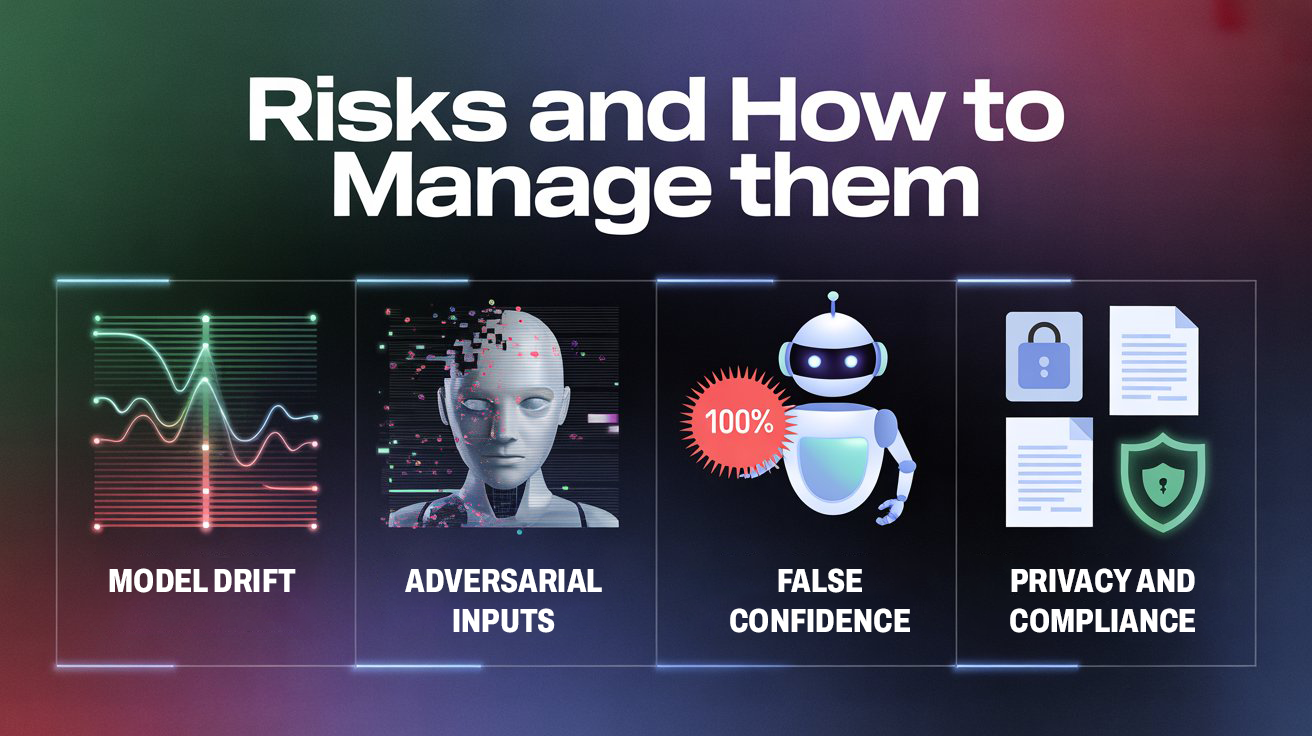
Despite its advantages, AI also introduces new risks. Attackers are now developing adversarial AI, using intelligent algorithms to bypass security defenses. Additionally, poorly trained AI models can misinterpret data, leading to privacy violations or false alerts.
Another challenge is data quality—AI systems rely heavily on accurate data for training. If the data is incomplete or biased, it may lead to wrong predictions. Ethical use of AI in cybersecurity requires transparency, fairness, and compliance with global data protection regulations.
Future of AI in Cybersecurity (2025 and Beyond)
The future of cybersecurity lies in autonomous defense systems powered by AI and ML. These intelligent frameworks will be able to self-heal networks, automatically patch vulnerabilities, and simulate attacks to strengthen defenses.
In 2025, we can expect greater integration of AI with Quantum Computing and Blockchain to build unbreakable encryption systems and more transparent data-sharing frameworks. Businesses that adopt AI-driven security will be better equipped to handle evolving cyber threats and maintain customer trust.
Conclusion
AI and Machine Learning are no longer optional—they are essential for modern cybersecurity. As cyber threats evolve, only intelligent, adaptive systems can provide the speed, precision, and foresight required to defend digital infrastructures. Organizations investing in AI-based cybersecurity tools not only protect their data but also strengthen their competitive advantage in the digital economy.
By combining human expertise with machine intelligence, the world moves closer to a future where cyber resilience is not just a goal—but a reality.